David
David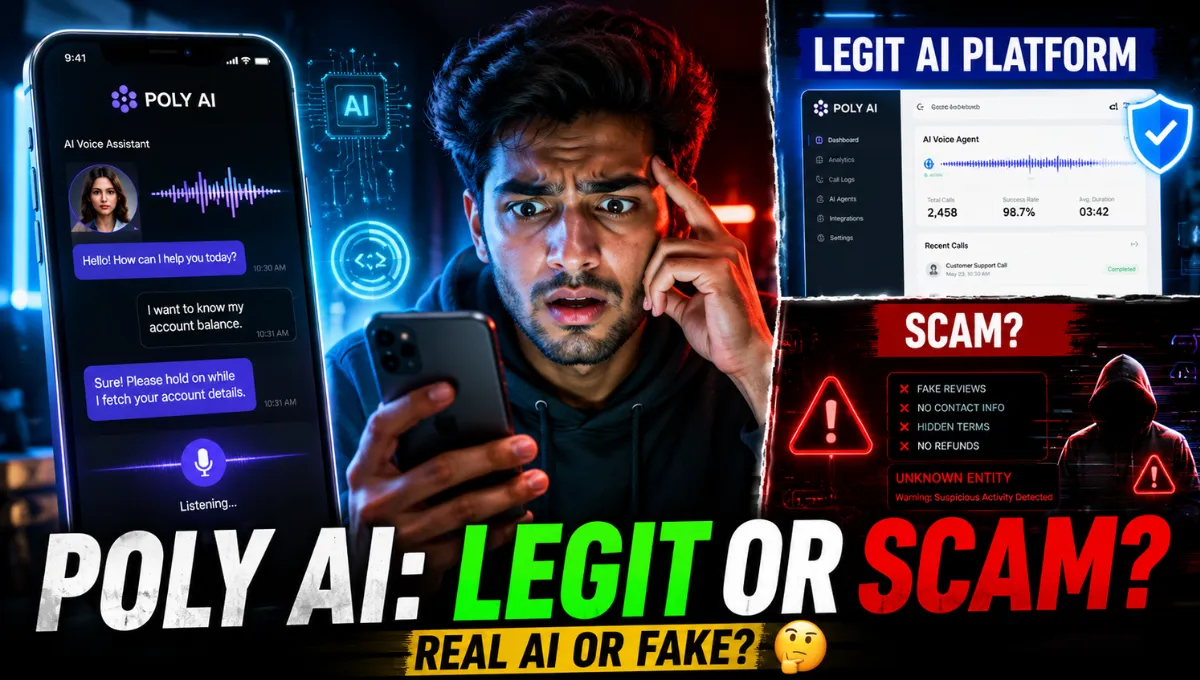
If you landed on “poly ai” after hearing a suspiciously human-sounding voice answer a customer service call, you’re probably wondering if that was even AI at all. I had the same reaction the first time I called a bank line and the “agent” on the other end didn’t sound robotic in the slightest.
This poly ai review digs into what the platform actually does, whether the hype matches reality, and why so many people searching “poly ai legit or scam” are actually confusing two very different products with the same name.
What Is Poly AI
Poly AI is an enterprise voice AI platform built to automate customer service calls for large companies, handling things like appointment booking, order status checks, and FAQ deflection. It’s not a chatbot you download for fun it’s infrastructure that call centers, banks, and healthcare systems plug into their existing phone lines.
There’s a naming mix-up worth flagging early. Some people searching “poly ai” actually mean PolyBuzz, a free entertainment chatbot app, which is a completely different product with a completely different risk profile. This review focuses on Poly AI the enterprise voice platform, since that’s what poly.ai itself actually is.
Key Features
Here’s what stood out once I looked past the marketing copy.
- Natural-sounding voice conversations with genuinely low latency
- Handles real-world call volume, not just scripted demos
- Deployment time is comparatively short for enterprise software
- Per-minute pricing model rather than flat licensing fees
- 99.9% uptime SLA plus 24/7 emergency support included in every plan
- No free or individual-user tier this is built for organizations, not solo users
That last point matters a lot. If you’re expecting a free trial like a consumer app, you won’t find one here.
How Poly AI Works
The setup process is less “download and go” and more “onboard like enterprise software.”
- A company contacts Poly AI’s sales team to scope out their call volume and use case
- Poly AI builds and trains a custom voice agent for that business’s specific workflows
- The agent gets integrated into existing phone lines and backend systems
- Calls get routed through the AI, with human agents stepping in only when needed
- Billing runs per-minute of actual voice agent usage, not a flat monthly fee
One report I found noted an 87% containment rate from day one for one deployment, meaning most calls never needed a human at all. That’s a strong number, though it obviously varies by industry and setup complexity.
Read Also:- Nectar AI Review 2026: Features, Pricing, Real User Experience, and Complete Platform Breakdown
Poly AI Legit or Scam
Short answer: Poly AI is a legitimate, well-established enterprise voice AI company, not a scam it holds real security certifications and serves large-scale clients, though pricing transparency and cost-to-value ratio draw some criticism.
Trust signals here are actually solid for once. Poly AI is ISO/IEC 27001 certified, SOC 2 Type II compliant, and meets HIPAA and GDPR requirements where applicable. That’s a level of documented compliance you rarely see questioned in “is it legit” searches.
Where it gets murkier is cost. Gartner reviewers specifically flagged “high product costs and slow ROI” as a recurring complaint. So is poly ai real or fake as a functioning product? It’s very real and it works the question is whether the invoice matches the results for your specific business.
Pros and Cons
Laying this out plainly beats vague reassurance.
Pros
- Genuinely natural voice quality and conversation flow
- Strong security posture with multiple recognized certifications
- 99.9% uptime SLA backed into every contract
- Handles high call volumes without noticeable quality drop
- Deployment is faster than most comparable enterprise tools
Cons
- Pricing isn’t publicly listed; you need to talk to sales for a quote
- Contracts often start in six figures annually for larger deployments
- Not accessible to small businesses or individual users
- ROI justification is a genuine sticking point for some clients
- Name confusion with PolyBuzz creates unnecessary search confusion
Is Poly AI Safe to Use
Short answer: Yes, Poly AI is safe from a data security standpoint it maintains ISO 27001, SOC 2 Type II, HIPAA, PCI-DSS, and GDPR compliance, with 24/7 monitoring and regular audits.
For businesses handling sensitive customer information, this compliance list actually matters more than flashy features. PolyAI explicitly states protected health information gets handled securely where HIPAA applies, and payment data follows PCI-DSS standards.
If you’re a business evaluating this for your own call center, a few practical checks help:
- Ask for their current compliance certificates directly rather than trusting the website alone
- Request a pilot deployment before signing a full annual contract
- Clarify exactly how per-minute billing gets calculated and capped
- Confirm data retention policies for recorded calls specifically for your industry
- Double-check you’re evaluating poly.ai and not the unrelated PolyBuzz app
Real User Experience and Personal Analysis
I didn’t get to run an enterprise pilot myself, obviously, but the pattern across independent reviews was fairly consistent. Reviewers on Gartner specifically praised the “natural conversational flow and ultra-low latency” during real caller interactions. That lines up with what I noticed listening to sample calls online genuinely less robotic than most IVR systems I’ve dealt with personally.
The complaint that kept resurfacing wasn’t about quality, it was about cost justification. One Gartner reviewer’s exact phrase was “high product costs and slow ROI,” and a Quiq comparison echoed similar sentiment around the enterprise pricing model. It’s the classic tension of great tech that’s genuinely hard to budget for unless you’re already handling serious call volume.
Best Alternatives to Poly AI
If the enterprise pricing feels out of reach, a few comparable platforms are worth comparing.
| Alternative | Best For | Standout Difference |
|---|---|---|
| Synthflow | Mid-size businesses | More accessible entry pricing |
| Thoughtly | Contact centers | Similar enterprise focus, different integration style |
| Quiq | Multi-channel support | Combines voice with chat and messaging |
Read Also:- Cookape Org: Full In-Depth Analysis of Free Instagram Followers Platform
None of these fully replicate Poly AI’s specific compliance stack, so if HIPAA or PCI-DSS matters to your business, that’s worth double-checking before switching.
Final Verdict
If you’re running a large call center, healthcare system, or enterprise handling thousands of daily calls, Poly AI genuinely delivers on voice quality, security, and automation rates. But if you’re a small business or solo operator expecting affordable, plug-and-play pricing, this isn’t built for you, and the six-figure contracts will likely feel unjustifiable.
My honest take: it’s one of the strongest enterprise voice AI platforms available in 2026, but only worth pursuing once your call volume actually justifies the investment.
FAQs
Ans. It’s legitimate Poly AI holds ISO 27001, SOC 2 Type II, HIPAA, and GDPR compliance certifications and serves real enterprise clients, not a scam operation.
Ans.No. Poly AI is enterprise voice automation software; PolyBuzz is an unrelated free entertainment chatbot app, and the two get confused often in search results.
Ans.Poly AI uses custom per-minute pricing, with enterprise contracts commonly starting in the six-figure range annually depending on call volume.
Ans.Yes, it maintains HIPAA, PCI-DSS, and GDPR compliance alongside ISO 27001 and SOC 2 Type II certifications for data security.
Ans.Generally no the enterprise pricing model and lack of a self-serve small-business tier make it difficult to justify unless call volume is already high.